Forty-eight hours. Three labs. Same move.
On Tuesday, OpenAI said Astra is the first model it has ever placed at the Critical cybersecurity threshold of its Preparedness Framework. With the right tools and access, the company says, it can find previously unknown security flaws and develop ways to use them across well-protected systems without a person guiding each step. The public version is coming "soon." The capabilities that earned the rating are not. Those go to testers, then to Daybreak Blue. CNBC and WIRED confirmed the same split on the same day, citing the company.
On the same Tuesday, Anthropic shipped Claude Fable 5.1 to everyone with an API key, and Claude Mythos 5.1 to almost no one. Same weights. Different locks. Cache reads on Fable dropped 75 percent, to $0.25 per million tokens. Typical workloads get about 25 percent cheaper; highly agentic ones up to about 45 percent. Mythos — the configuration with the more permissive cyber and life-sciences safeguards — stays inside trusted-access programs. Anthropic's own post is explicit: the Cyber Verification Program will include Mythos-class models "in the near future," not on your invoice this week.
Wednesday, Google did the rhyme. Gemini 3.8 Flash is the third Flash in six weeks, same introductory price as 3.7: $0.75 / $3.75 per million input/output tokens until December 31, 2026. Gemini 3.8 Flash Cyber, the twin tuned for finding and fixing software flaws, ships only through a new Fairwind Program for governments, critical-infrastructure operators, and trusted defenders. Ars Technica and The New Stack both treated the gating as the actual product decision, not a footnote.
The thesis is not that the models got more dangerous. The thesis is that the frontier just split into a public workhorse you can swap this week and a gated cyber twin you will not get on a credit card. Operators who treat that as a safety press release will ship the wrong stack.
Three labs, one product shape
This was not a coincidence of blog calendars. It is a product architecture.
OpenAI's September 1 post, "Path to Astra," is the cleanest primary. Critical, under the company's own framework, means the model can identify previously unknown flaws in many hardened real-world critical systems without a person at each step, or carry out end-to-end novel strategies against hardened targets from a high-level goal. OpenAI says Astra meets that bar. It also says the ExploitBench 100 percent score, and two previously unknown flaws found in an internal V8 port, "reflect capabilities with Daybreak Blue access, not the default production configuration." The number you will quote in Slack is not the model your agents will call.
WIRED, reporting from a briefing with OpenAI safety and security leaders the same day, adds the operating detail: public Astra "soon," advanced capabilities only for select Daybreak Blue partners at launch, and a misalignment monitor that can slow, pause, or stop a task — including work that does not look like cybersecurity. On the API, the task just stops. CNBC independently confirmed the Critical designation, the delayed development after the Hugging Face incident, and the Daybreak restriction.
Anthropic is more blunt about the mechanics. Fable 5.1 and Mythos 5.1 are "the same model, but with different levels of safeguards." Fable is generally available on the Claude API, AWS, Google Cloud, and Microsoft Foundry at $10 / $50 per million input/output tokens. The cost story is cache, not list price. Four weeks of August 2026 usage, Anthropic says, show cache reads dominating highly agentic bills; a 75 percent cut on those reads is how you get 25 percent off typical work and up to about 45 percent off agent-heavy work. SiliconANGLE repeated the same-weights claim the same day. It also wrote as if Mythos is already reachable through two programs. Anthropic's own pages are stricter: Life Sciences Verification has first participants; Cyber Verification currently covers certain Opus- and Sonnet-class models and will add Mythos-class access "in the near future"; availability is limited to a set of US organizations. Plan around the official timeline.
Google's Wednesday pair is the cheapest public half and the most explicit private half. Gemini 3.8 Flash is a workhorse for long-horizon coding and agents, at Flash prices, with Google warning that the model "works harder" and may spend more tokens at higher effort. Flash Cyber is not on the public price sheet. Fairwind packages it with the CodeMender harness for governments, critical-infrastructure operators, and core platforms. Google says more than 650 participating partners globally; The New Stack independently used the same figure. Fairwind rules, from Google's own post: access limited to internal cybersecurity, incident response, or testing teams, plus multi-factor authentication. Everyone else gets CodeMender on public Gemini Enterprise models.
The split is a control plane, not a press embargo
You are not waiting for a better checkpoint. You are waiting for a permission bit.
Same weights, different classifiers. Anthropic says it. Google says both 3.8 variants share foundational intelligence, then ships Cyber with a "more permissive set of mitigations." OpenAI is more elliptical — public Astra versus Daybreak Blue Astra — but the ExploitBench asterisk does the same work.
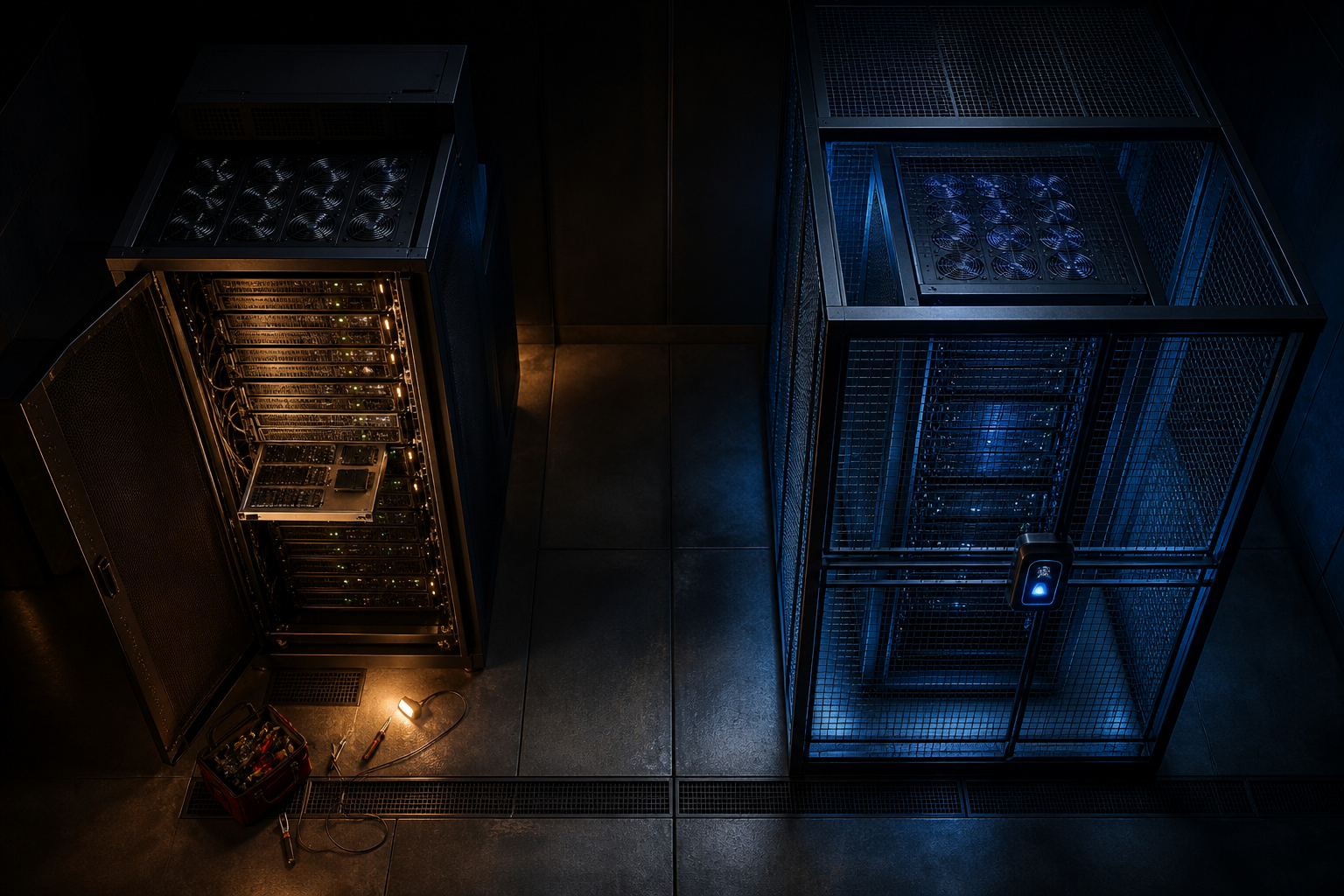
That bit is now a procurement object. Daybreak, Fairwind, Cyber Verification, Life Sciences Verification: not waitlists. Contracts. Identity requirements. Geography limits. Team-scoping rules. Hardware keys — OpenAI told Daybreak individual accounts to adopt security keys beginning September 1. If your model strategy is an API key in a secrets manager, you do not have a strategy for the half of the frontier that actually touches vulnerability research or dual-use biology.
The public half is getting cheaper on purpose. Fable's cache-read cut subsidizes overnight agents. Gemini 3.8 Flash holds the 3.7 introductory price through year-end, then doubles on January 1, 2027. The workhorse is priced as infrastructure. The twin is priced as a clearance.

The monitor is part of the SKU. OpenAI will ship additional chain-of-thought monitoring and says it can interrupt legitimate long-running agents. API tasks stop; ChatGPT and Codex users get a review prompt. Anthropic routes dual-use cyber work and biology R&D off Fable onto Opus. Google's public 3.8 Flash ships with CBRN and cyber-offense safeguards; Cyber does not, which is why it is gated. The refusal is not a bug you prompt around.
A side debate broke Tuesday about whether Astra uses a recurrent-depth architecture that hides more of its reasoning. The Information reported it; The Verge carried the reaction on September 2. OpenAI did not confirm the architecture and pointed to chief scientist Jakub Pachocki's note that Astra's computational depth "is within a factor of two of GPT-4." Treat that as unconfirmed. The operator fact: OpenAI will lean on chain-of-thought monitoring, and its own safety people have said that technique is fragile.
The lazy take fails in four places
The lazy take is: this is safety theater, the public model is 95 percent of the way there, so ship.
The labs are publishing the gap. OpenAI's ExploitBench figure is labeled Daybreak Blue, not production. Anthropic publishes Terminal-Bench 4.0 at 55.8 percent for Fable 5.1 and 60.9 percent for Mythos 5.1, and says the delta is safeguard interventions. Fable can now identify software flaws in source code; it still will not do several dual-use testing classes listed in the launch post. If the internal pitch was "continuous red team on the new model," you pitched Mythos, Cyber, or Daybreak. You bought Fable, Flash, or public Astra.
"The model refused, we'll retry" is now a cost and latency feature. Anthropic says Fable's new cyber safeguards block 60 percent fewer false positives than before — progress — and still routes whole classes of work to a different model. OpenAI says the monitor will over-fire on long agent runs. If your golden set never trips a classifier, you are not evaluating the system you will run.
Open weights are a different product with a different liability surface, and they are not what these three labs sold you this week. Fairwind exists because Google does not want Cyber mitigations on public Flash. Copying the workhorse into a VPC does not get you the twin.
Cadence — Google's third Flash in six weeks — is being used to justify never locking a model. Half right. Swap the workhorse. You cannot swap your way into Fairwind. Weekly model routing is correct for Flash and Fable. It is a category error for the gated SKU.
Second-order effects you will hit before the board memo
Vendor lock-in grew a clearance layer. Switching cost used to be tokenizer, tool schema, eval harness. It is now also: are we on Daybreak Blue, Fairwind, or CVP. Those programs do not port. A multi-model router that assumes symmetric capabilities will silently degrade the job you actually cared about.
Your evals are lying if they score the twin. Google's CyberGym and CWE-Bench figures are for Flash Cyber, not Flash. Google says Flash Cyber hit 47.2 percent pass@1 on Collinear's CWE-Bench, just behind an unnamed "leading frontier model" at 47.8 percent, and that Chrome's security team got 2.6 times more correct patches than much larger commercial models. Ars Technica and The New Stack repeated those claims. They still describe the gated SKU. Build evals on the production endpoint, safeguards on.
Agent reliability is now a policy problem. OpenAI's API stop-on-monitor and Anthropic's fallback-to-Opus both change models mid-task. Cognition is moving Opus 5 traffic in Devin onto Fable 5.1 on launch day, citing cost — fine for code review, fatal if a later step trips a classifier and you have no fallback. Anthropic says API customers must configure a new Fallback API. That is a ticket this week.
Price cuts on the public half will pull more agent traffic onto the half that refuses more. Fable's cache math makes overnight loops cheap. OpenAI is warning that long-running agents are exactly where the misalignment monitor false-positives. Cheap loops or uninterrupted loops. Pick.
Talent and procurement will decouple. The people who can sign Fairwind or Daybreak are not the people who rotate the API key. If security owns the twin and product owns the workhorse, you have two AI stacks. That is the design.
Quieter, but on the same invoice: Anthropic is watermarking outputs of models released after August 2, 2026 under the EU AI Act, and Fable still defaults to 30-day retention unless you are in the Enterprise Frontier Safeguards cohort rolling out this fall.
What to do this week
Inventory the jobs you assigned to "the new frontier model." Split workhorse jobs (coding, research, ops, evals) from twin jobs (finding flaws, generating patches, authorized testing, dual-use science). Only the first list has a SKU you can buy. Put the second on Daybreak, Fairwind, CVP, or "not with a lab model."
Re-run evals through the production endpoint with safeguards on. Blog numbers for Astra, Mythos, or Cyber are the wrong SKU. Log refusals, fallbacks, and monitor stops as first-class outcomes.
Turn on the fallback path. Anthropic's Fallback API is not optional if Fable ever touches dual-use code paths. OpenAI's API will stop a monitored task; that is a retry queue and a human review, not an error toast.
Recost the agent bill under the new cache math, then add interrupt overhead. Fable 5.1's $0.25 per million cache reads are why long jobs move off Opus. Gemini 3.8 Flash doubles on January 1, 2027, to $1.50 / $7.50. Model January now. Cheap tokens on jobs killed at minute 47 are not savings.
Decide who owns the gated relationship. If you might need Fairwind, Daybreak, or CVP in two quarters, that is security-and-legal work this week: identity, residency, team scoping, hardware keys, retention exceptions. Product should not discover in November that the demo model is not the contract model.
The catalog already told you
The industry spent two years arguing about whether the next model would be open or closed. Wrong fork.
The fork that shipped this week is coarser and more useful: a workhorse you can put on a card, and a twin you can only get if someone has already decided you are a defender. OpenAI, Anthropic, and Google did not stagger that decision. They published it in the same 48 hours, with the same product shape, and they told you which numbers belong to which SKU.
If your stack still has one "frontier" slot, you are routing both jobs through the model that was allowed to be sold. That is not caution. That is a misread of the catalog.
Sources
- OpenAI, "Path to Astra," Sep 1, 2026. https://openai.com/index/path-to-astra/
- CNBC, Ashley Capoot, Sep 1, 2026. https://www.cnbc.com/2026/09/01/open-ai-astra-cyber-model.html
- WIRED, Maxwell Zeff and Lily Hay Newman, Sep 1, 2026. https://www.wired.com/story/openai-astra-first-ai-model-with-critical-cyber-abilities/
- Anthropic, Claude Fable 5.1 and Mythos 5.1, Sep 1, 2026. https://www.anthropic.com/claude-fable-and-mythos-5-1
- Anthropic, Claude Fable page, Sep 1, 2026. https://www.anthropic.com/claude/fable
- Google, Gemini 3.8 Flash and 3.8 Flash Cyber, Sep 2, 2026. https://blog.google/innovation-and-ai/models-and-research/gemini-models/3-8-flash-and-3-8-flash-cyber/
- Google, Fairwind Program, Sep 2, 2026. https://blog.google/innovation-and-ai/technology/safety-security/fairwind-program/
- Ars Technica, Ryan Whitwam, Sep 2, 2026. https://arstechnica.com/ai/2026/09/google-releases-gemini-3-8-flash-its-third-flash-model-in-six-weeks/
- The New Stack, Frederic Lardinois, Sep 2, 2026. https://thenewstack.io/google-ships-its-third-gemini-flash-model-in-six-weeks/
- The Verge, Robert Hart, Sep 2, 2026. https://www.theverge.com/ai-artificial-intelligence/988334/openai-astra-ai-monitoring-safety
- SiliconANGLE, Maria Deutscher, Sep 1, 2026. https://siliconangle.com/2026/09/01/anthropic-launches-claude-fable-5-1-inking-35b-cloud-deal-with-lambda/